Zomint Blog
Zomint Blog
Zomint Blog
How to Invest in GIFT CITY ?
Nov 17, 2025

90% of the world’s wealth creation in the last 15 years came from companies Indians can’t even buy.
Apple. Nvidia. Amazon. Microsoft. Tesla.
All out of reach.
Meanwhile, the rupee has lost 64% of its value against the US dollar…
And Indian markets have underperformed many global markets over the last decade.
Yet investing globally has remained painfully difficult for most Indians. That changes now.
A new opportunity has opened up in India and now any Indian can invest in global markets through mutual funds which invest directly in global markets. It's very new and not a lot of people know about it.
Why Indians Want to Invest Globally ?
For most Indians, global investing was earlier seen as “optional.”
Today, it has become almost necessary for better long-term wealth creation.
Invest in Top Global Companies: You can’t buy Apple, Microsoft, or Nvidia on Indian markets.Investing globally gives you access to invest in the world's best companies.
USD Benefits: The Rupee has consistently weakened against the USD for 20+ years. Investing in USD protects your wealth from this depreciation.
Reduce Risk by Diversification : Global diversification ensures your entire wealth doesn't suffer if India faces a temporary slowdown.
Capture Global Market Cycles: You benefit from multiple growth waves worldwide.
But Most Indians Can't Invest Globally
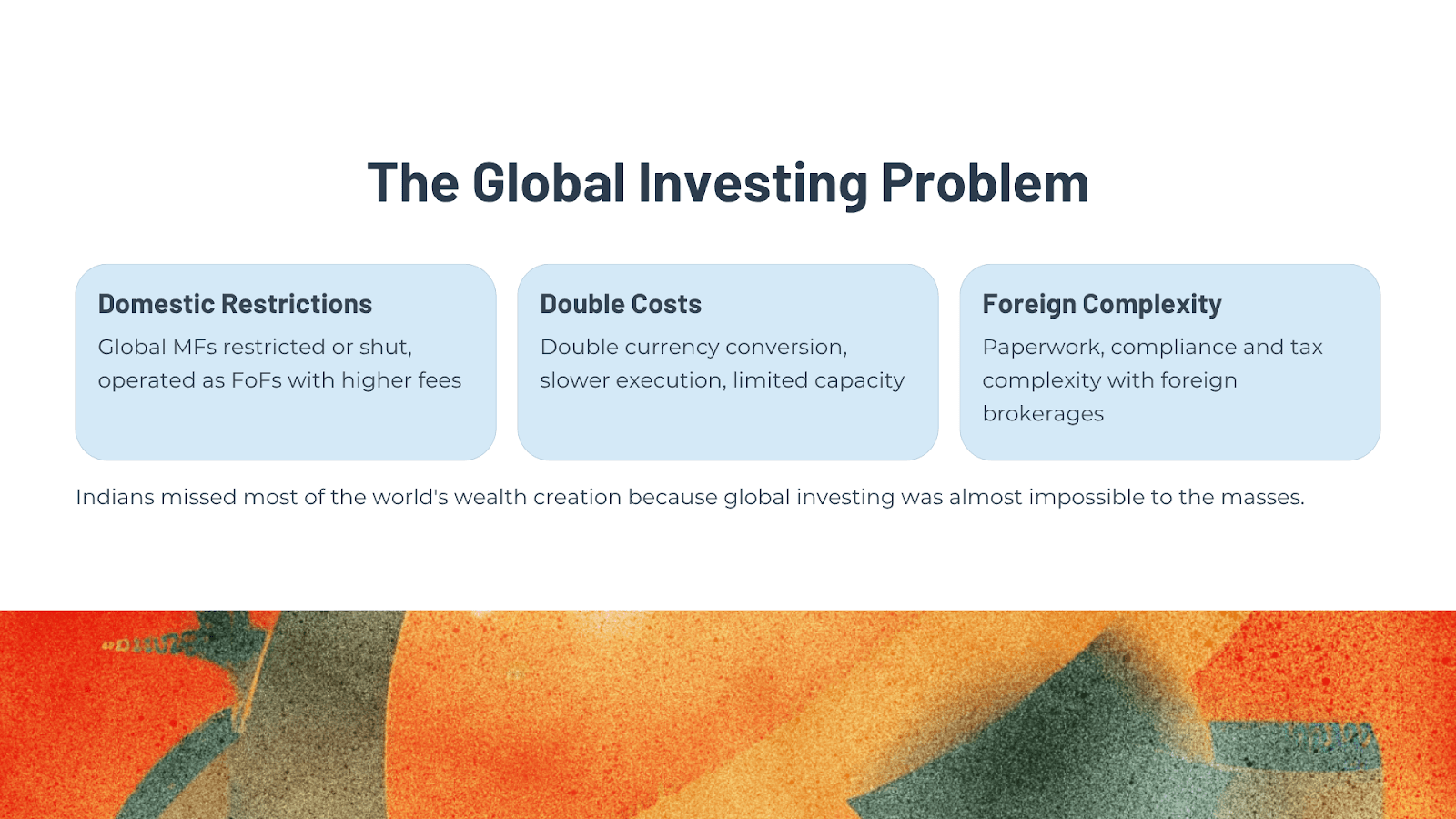
Even though investing globally has become essential, most Indians still can’t do it easily. They don’t know where to invest, how different global markets work, or where to find reliable research.
Naturally, the simplest solution should have been global mutual funds.
But here’s the problem: almost all domestic international mutual funds in India are either shut, restricted, or accepting only very small amounts. And this isn’t because fund houses don’t want to offer them. The real issue is the strict limits placed on how much money Indian fund houses can invest overseas.
And even when these funds are open to invest, there is a major structural problem. Most Indian “global” mutual funds don’t buy global stocks directly.
They work as FoFs (Funds of Funds). That means your money is converted to USD and then invested into another international fund abroad and not directly in the global market.
This creates three issues:
Double Expense Ratio
You pay the Indian fund’s fee plus the foreign fund’s fee, which eats into returns.Extra Currency Conversion Costs
Every conversion, INR to USD and back adds charges and reduces final returns.Slower Execution & Higher Friction
Because the Indian fund depends on the overseas fund’s timelines, buy/sell decisions face delays and tracking errors.
Apart from mutual funds, Indians can invest globally through foreign brokerage accounts or international ETFs — but these come with their own challenges.
There is too much documentation, unclear rules, complicated annual tax filing, and overall high costs.For most people, global investing from India is simply not an easy or practical option.
This is the gap which GIFT City Funds wants to fill perfectly
What Is GIFT City ?
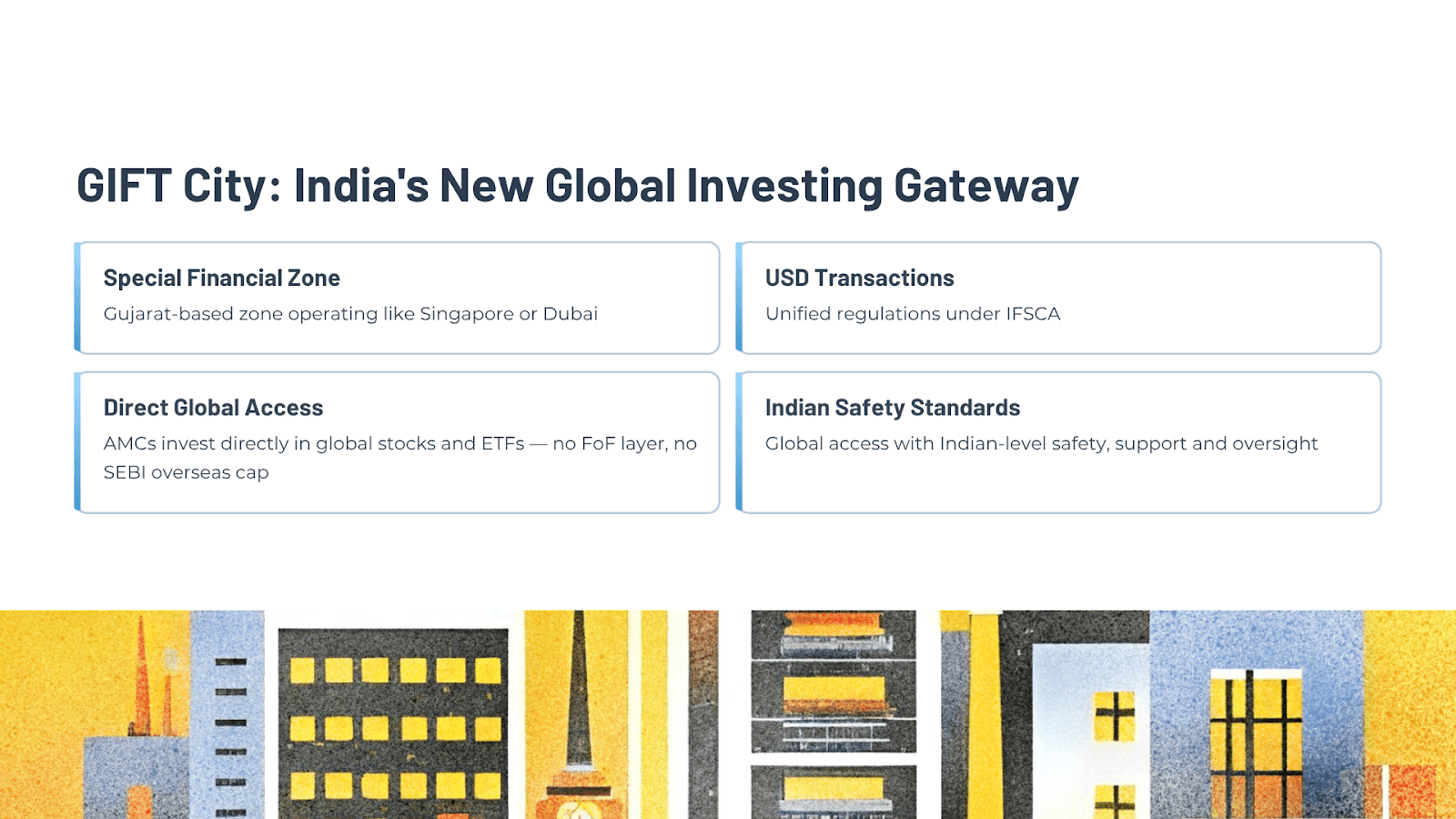
GIFT City is a special financial zone inside Gujarat, but it works very differently from the rest of India. It is designed to function like Singapore or Dubai, where global banking, investing and fund management can happen smoothly in foreign currency without the usual Indian restrictions.
The entire zone is regulated by IFSCA (International Financial Services Centres Authority). IFSCA combines the powers of SEBI, RBI, IRDAI and PFRDA, which makes regulation simple and unified.
The key idea of GIFT City is that it operates like an offshore financial centre. An offshore financial centre is a special zone where financial activities can happen in foreign currency, with lighter restrictions and more flexible rules compared to the rest of the country.
Because of this structure, transactions in GIFT City happen in USD, mutual funds can invest abroad without SEBI’s overseas limit and global fund structures are allowed. At the same time, investors still get the comfort of Indian fund houses, Indian customer support and Indian legal protection.
The best part is that Indian mutual fund houses have set up separate GIFT City units that can launch foreign funds which directly invest in global stocks, global ETFs or international indices. These funds are not counted under the SEBI or RBI seven billion dollar overseas cap, so they can continue accepting money without any restrictions.
What Types of Global Mutual Funds You Can Invest in Through GIFT City
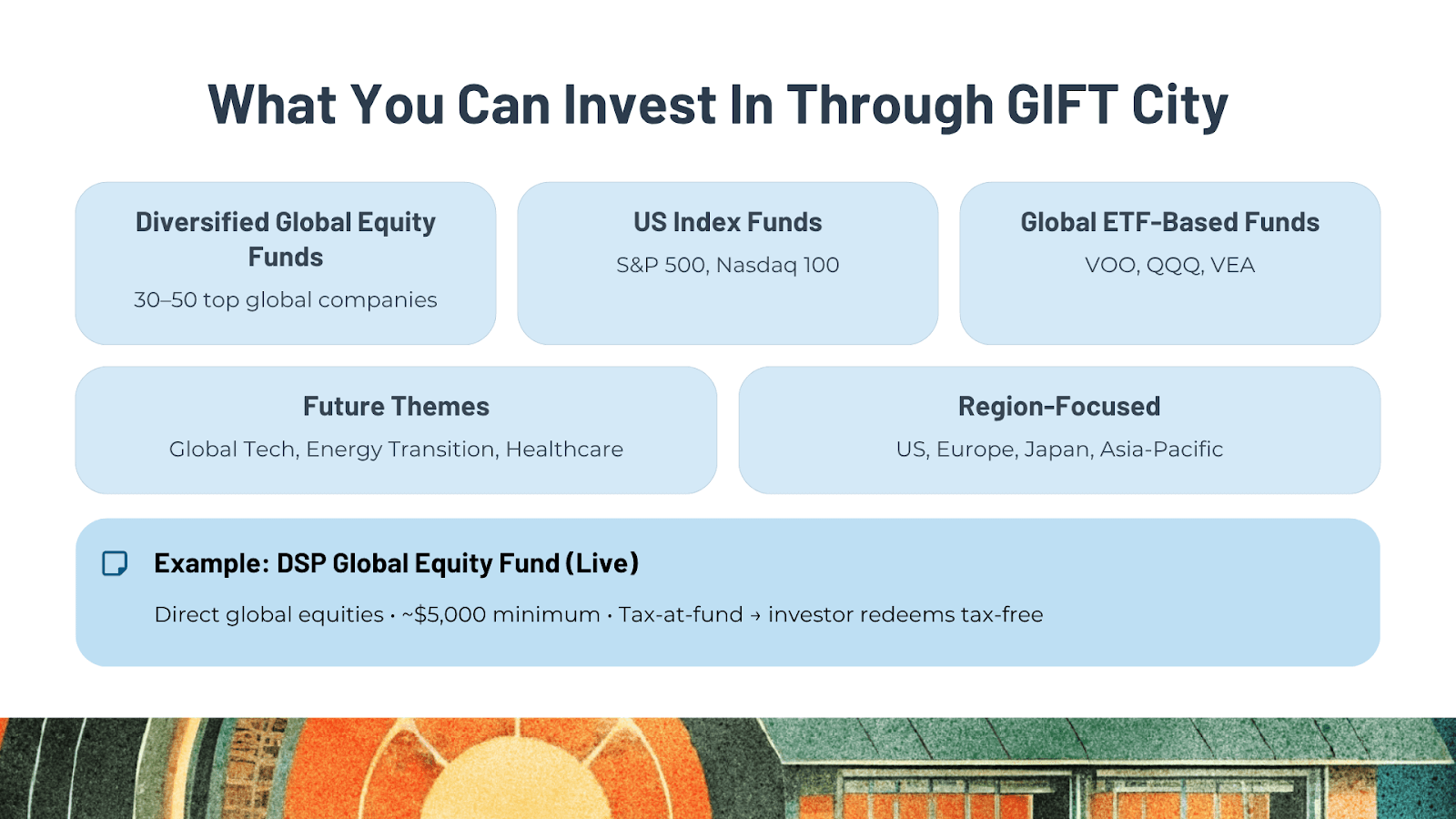
One of GIFT City’s biggest strengths is the wide range of global mutual funds it can host. Unlike domestic international funds which are restricted, paused or forced to operate as FoFs, GIFT City funds can be built just like global funds abroad.
Here is a simple overview of what investors can access in GIFT City:
1. Diversified Global Equity Funds
These funds invest across multiple countries and sectors, usually holding 30 to 50 leading global companies.
2. US-Focused Funds (S&P 500, Nasdaq 100, Big Tech)
Several new GIFT City funds will offer direct access to the S&P 500, Nasdaq 100 and other US large-cap strategies. This means exposure to Apple, Microsoft, Google, Amazon, Meta and Nvidia without FoF
3. Global ETF-Based Funds
Some funds simply buy international ETFs like VOO, QQQ or VEA. This keeps costs low while offering broad diversification.
4. Thematic and Sector-Based Funds (Future Possibility)
GIFT City also allows future thematic launches in areas like global technology, healthcare, energy transition or consumer trends.
5. Region-Specific Global Funds
AMCs can build funds focused on regions like Europe, Japan, Asia-Pacific or emerging markets. These options are rare in India’s domestic MF ecosystem.
Note - Only Diversified Global Equity fund is available through DSP Global Equity Fund, rest of them will come soon.
Major GIFT City Funds | DSP Global Equity Fund
GIFT City is still a young ecosystem, so only one major global fund is live right now. The rest are filed or in the planning stage and will launch gradually over the next few months.
1. DSP Global Equity Fund (IFSC) — Currently Live
Status: Live and open for investment
Strategy: Diversified global equity (30–50 stocks across the US, Europe, Japan and Asia)
Minimum Investment: 5,000 dollars (approx. ₹4.15 lakh) initial and 500 dollars additional
How It Invests: Direct global equities, not FoFs (Fund of Funds)
Taxation: Tax-at-fund model; redemption is tax-free for investors
Upcoming GIFT City Foreign Funds
Here are the major funds that are filed, expected or in planning stages:
Fund / AMC | Status | Strategy | Best For |
PPFAS Global Fund | Filed, launch expected | Concentrated, long-term global equity | Long-term buy-and-hold global investors |
Mirae Asset Global Funds | In planning | S&P 500, Nasdaq 100, global ETF-based funds | Low-cost index-based global exposure |
Tata AMC Global Funds | Filed | US-focused and multi-market global funds | Investors who prefer Tata’s consistency and brand |
Another three to four AMCs are preparing to launch global funds in GIFT City, including global index funds, ETF baskets and region-focused strategies.
Who Should Invest in GIFT City Funds?
GIFT City is not for everyone — and that’s why it works beautifully for the right kind of investor. It sits perfectly between simple domestic funds and complicated foreign accounts, offering global access without restrictions or tax stress.
1. Investors Planning a Serious Global Allocation
If you want to invest three to five lakh rupees or more, GIFT City is the most reliable route and that too without Foreign Compliance
2. Investors Who Believe in USD-Based Wealth
If you prefer building wealth in a stronger currency, GIFT City lets you hold, invest and redeem in USD — giving long-term currency advantage.
3. Investors Who Want Global Giants in Their Portfolio
You cannot buy Apple, Nvidia, Google or Tesla on Indian exchanges. GIFT City funds offer clean, direct access without FoF layers.
4. Investors With USD-Based Goals
Ideal for foreign education, global retirement, international relocation, long-term travel or simply building USD wealth.
Taxation Rules for GIFT City You Must Know
Taxation of international funds at GIFT City can feel confusing at first, but the structure is actually designed to make things simple for investors.
A good example is the DSP Global Equity Fund (IFSC).
What surprises most people is this:You, the investor, pay zero tax on your gains when you redeem.
This does not mean the fund is tax-free.Instead, the tax is paid inside the fund itself.
Taxation Summary
Tax Component | How It Works | Who Pays | Rate / Notes |
Capital Gains (Fund Sells Before 2 Years) | Tax paid internally by the fund | Fund | Up to 43% at fund level |
Capital Gains (Fund Sells After 2 Years) | Tax paid internally by the fund | Fund | 14.95% |
Dividends Received by Fund | Tax deducted at source abroad and settled by fund | Fund | Around 36% |
TCS Under LRS
If your total remittance under LRS in a financial year is:
Below ₹10 lakh → No TCS
Above ₹10 lakh → 20% TCS only on the extra amount
Example:
If you remit ₹11 lakh, TCS applies only on ₹1 lakh → TCS = ₹20,000.
This is not a tax, and you can claim it back in your ITR.
How to Invest in GIFT City - Complete Guide
Investing in international funds through GIFT City is still partly online and partly offline, and DSP Global Equity Fund (IFSC) gives a clear example of how the process currently works.
1. Creating a Zero Folio (Account Opening)
To begin, you need to create a Zero Folio with DSP IFSC.
You download the application form from DSP IFSC’s website, fill it out and email it to DSP IFSC along with the required documents. CAMS reviews the form and, if everything is correct, your Zero Folio is created within T+2 working days. This folio acts as your dedicated investment account for GIFT City funds.
2. Remitting Funds to DSP IFSC
Once your Zero Folio is created, you can transfer money to DSP’s GIFT City bank account.Since this transfer happens through the Liberalised Remittance Scheme (LRS), it involves INR being converted to USD and then sent to your DSP IFSC folio.
At present, this step makes the onboarding a mix of online and offline processes, but DSP is working to make it fully online soon.
3. Unit Allocation Timeline
After you remit funds, the AMC typically allots units within T+1 business day, subject to receiving all confirmations. The cut-off time for same-day processing is 12 p.m (noon). Once units are allotted, you receive an official confirmation and your holdings show up in your account statement or dashboard.
4. Redemption Process and Timelines
When you redeem your investment, the proceeds are paid into your designated bank account. Redemptions are processed within seven business days, and the amount you receive is net of taxes, fees, transaction costs and other applicable charges.
For partial redemptions, if your remaining investment value drops below 1,000 dollars, the fund house may redeem your entire balance.
Also note that DSP IFSC has an exit load of 1 percent for redemptions made within 24 months of the investment date.
Should You Invest in GIFT City Fund?
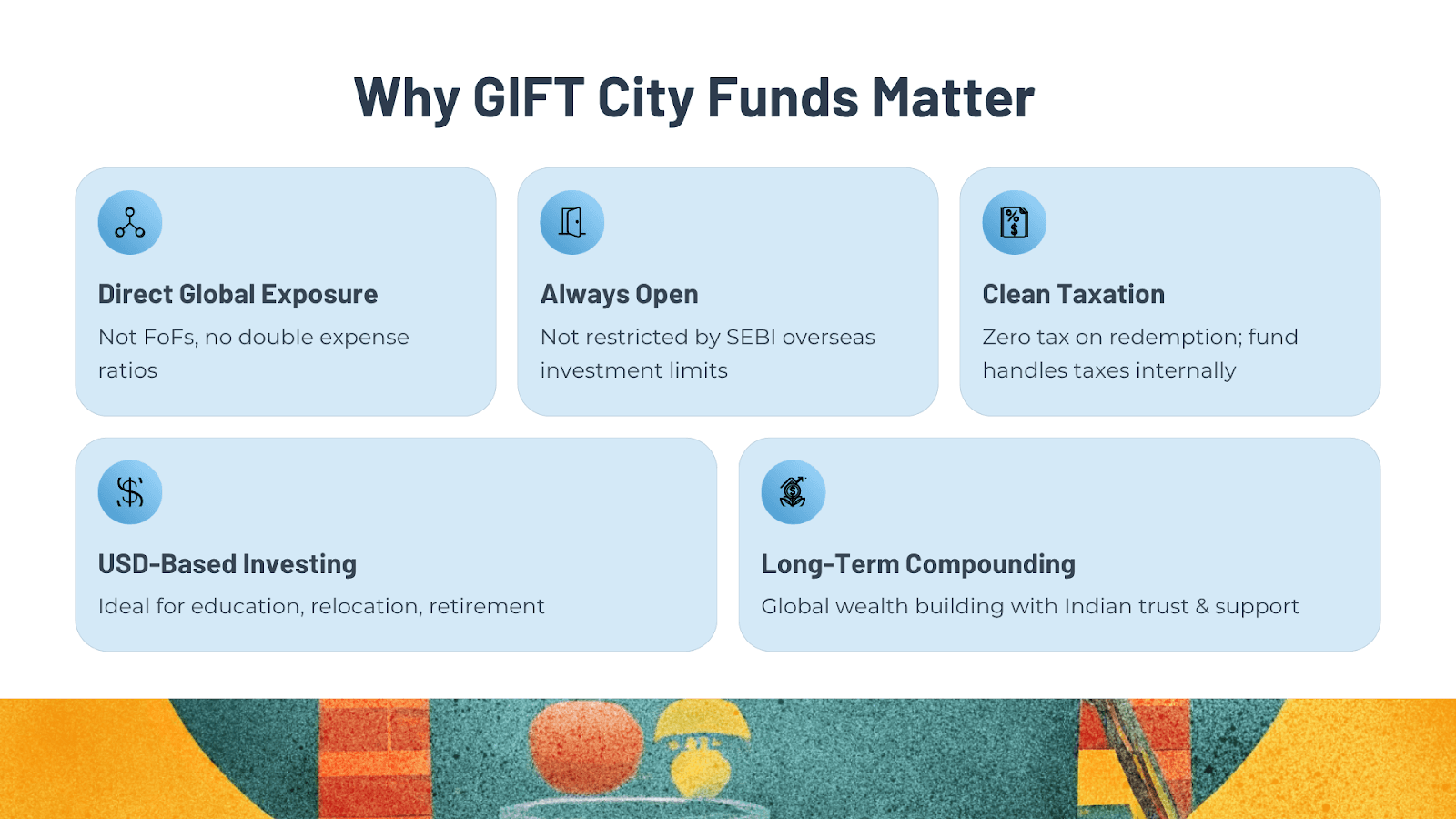
Advantages
1. Stability and Consistency
Domestic global mutual funds can pause anytime because of SEBI’s overseas cap. GIFT City funds don’t face this limit, so they remain open for fresh investments. For long-term planners, this stability is a big win.
2. Clean Taxation
Most GIFT City funds use a tax-at-fund model. Taxes are handled inside the fund, and you receive redemption proceeds cleanly without foreign filings, W-8BEN forms or US capital-gains reporting.
3. Direct Global Exposure
Unlike domestic FoFs, GIFT City funds invest directly in global stocks or ETFs. No double expense ratios. No extra layers. You get pure global exposure.
4. USD-Based Investing
Investments stay in USD, which helps if you believe the dollar will remain strong or if you have USD-linked goals like foreign education or global retirement.
5. Indian Oversight and Support
Everything runs through Indian AMCs and Indian banks. No foreign broker risks, no compliance confusion and no regulatory uncertainty.
Limitations
1. Higher Minimum Amounts
Most GIFT City funds require 500 to 5,000 dollars. This may feel heavy for small SIP or low-ticket investors.
2. New Ecosystem
GIFT City is still young. Fund choices are limited today and will expand over time. Early adopters need patience.
3. Tax Complexity at Fund Level
While taxation is simple for investors, the fund pays high taxes internally (for example, DSP Global Equity Fund pays up to 43 percent on short-term gains). This may reduce fund-level returns in certain market phases.
4. Not Ideal for Short-Term Investing
Global investing works best over the long term. If you want quick returns, this route may disappoint.
If you want a personalised allocation plan for global investing through GIFT City, just book a free call with our SEBI-registered experts by clicking here.
We’ll guide you based on your risk profile, goals, and investment amount.
90% of the world’s wealth creation in the last 15 years came from companies Indians can’t even buy.
Apple. Nvidia. Amazon. Microsoft. Tesla.
All out of reach.
Meanwhile, the rupee has lost 64% of its value against the US dollar…
And Indian markets have underperformed many global markets over the last decade.
Yet investing globally has remained painfully difficult for most Indians. That changes now.
A new opportunity has opened up in India and now any Indian can invest in global markets through mutual funds which invest directly in global markets. It's very new and not a lot of people know about it.
Why Indians Want to Invest Globally ?
For most Indians, global investing was earlier seen as “optional.”
Today, it has become almost necessary for better long-term wealth creation.
Invest in Top Global Companies: You can’t buy Apple, Microsoft, or Nvidia on Indian markets.Investing globally gives you access to invest in the world's best companies.
USD Benefits: The Rupee has consistently weakened against the USD for 20+ years. Investing in USD protects your wealth from this depreciation.
Reduce Risk by Diversification : Global diversification ensures your entire wealth doesn't suffer if India faces a temporary slowdown.
Capture Global Market Cycles: You benefit from multiple growth waves worldwide.
But Most Indians Can't Invest Globally
Even though investing globally has become essential, most Indians still can’t do it easily. They don’t know where to invest, how different global markets work, or where to find reliable research.
Naturally, the simplest solution should have been global mutual funds.
But here’s the problem: almost all domestic international mutual funds in India are either shut, restricted, or accepting only very small amounts. And this isn’t because fund houses don’t want to offer them. The real issue is the strict limits placed on how much money Indian fund houses can invest overseas.
And even when these funds are open to invest, there is a major structural problem. Most Indian “global” mutual funds don’t buy global stocks directly.
They work as FoFs (Funds of Funds). That means your money is converted to USD and then invested into another international fund abroad and not directly in the global market.
This creates three issues:
Double Expense Ratio
You pay the Indian fund’s fee plus the foreign fund’s fee, which eats into returns.Extra Currency Conversion Costs
Every conversion, INR to USD and back adds charges and reduces final returns.Slower Execution & Higher Friction
Because the Indian fund depends on the overseas fund’s timelines, buy/sell decisions face delays and tracking errors.
Apart from mutual funds, Indians can invest globally through foreign brokerage accounts or international ETFs — but these come with their own challenges.
There is too much documentation, unclear rules, complicated annual tax filing, and overall high costs.For most people, global investing from India is simply not an easy or practical option.
This is the gap which GIFT City Funds wants to fill perfectly
What Is GIFT City ?
GIFT City is a special financial zone inside Gujarat, but it works very differently from the rest of India. It is designed to function like Singapore or Dubai, where global banking, investing and fund management can happen smoothly in foreign currency without the usual Indian restrictions.
The entire zone is regulated by IFSCA (International Financial Services Centres Authority). IFSCA combines the powers of SEBI, RBI, IRDAI and PFRDA, which makes regulation simple and unified.
The key idea of GIFT City is that it operates like an offshore financial centre. An offshore financial centre is a special zone where financial activities can happen in foreign currency, with lighter restrictions and more flexible rules compared to the rest of the country.
Because of this structure, transactions in GIFT City happen in USD, mutual funds can invest abroad without SEBI’s overseas limit and global fund structures are allowed. At the same time, investors still get the comfort of Indian fund houses, Indian customer support and Indian legal protection.
The best part is that Indian mutual fund houses have set up separate GIFT City units that can launch foreign funds which directly invest in global stocks, global ETFs or international indices. These funds are not counted under the SEBI or RBI seven billion dollar overseas cap, so they can continue accepting money without any restrictions.
What Types of Global Mutual Funds You Can Invest in Through GIFT City
One of GIFT City’s biggest strengths is the wide range of global mutual funds it can host. Unlike domestic international funds which are restricted, paused or forced to operate as FoFs, GIFT City funds can be built just like global funds abroad.
Here is a simple overview of what investors can access in GIFT City:
1. Diversified Global Equity Funds
These funds invest across multiple countries and sectors, usually holding 30 to 50 leading global companies.
2. US-Focused Funds (S&P 500, Nasdaq 100, Big Tech)
Several new GIFT City funds will offer direct access to the S&P 500, Nasdaq 100 and other US large-cap strategies. This means exposure to Apple, Microsoft, Google, Amazon, Meta and Nvidia without FoF
3. Global ETF-Based Funds
Some funds simply buy international ETFs like VOO, QQQ or VEA. This keeps costs low while offering broad diversification.
4. Thematic and Sector-Based Funds (Future Possibility)
GIFT City also allows future thematic launches in areas like global technology, healthcare, energy transition or consumer trends.
5. Region-Specific Global Funds
AMCs can build funds focused on regions like Europe, Japan, Asia-Pacific or emerging markets. These options are rare in India’s domestic MF ecosystem.
Note - Only Diversified Global Equity fund is available through DSP Global Equity Fund, rest of them will come soon.
Major GIFT City Funds | DSP Global Equity Fund
GIFT City is still a young ecosystem, so only one major global fund is live right now. The rest are filed or in the planning stage and will launch gradually over the next few months.
1. DSP Global Equity Fund (IFSC) — Currently Live
Status: Live and open for investment
Strategy: Diversified global equity (30–50 stocks across the US, Europe, Japan and Asia)
Minimum Investment: 5,000 dollars (approx. ₹4.15 lakh) initial and 500 dollars additional
How It Invests: Direct global equities, not FoFs (Fund of Funds)
Taxation: Tax-at-fund model; redemption is tax-free for investors
Upcoming GIFT City Foreign Funds
Here are the major funds that are filed, expected or in planning stages:
Fund / AMC | Status | Strategy | Best For |
PPFAS Global Fund | Filed, launch expected | Concentrated, long-term global equity | Long-term buy-and-hold global investors |
Mirae Asset Global Funds | In planning | S&P 500, Nasdaq 100, global ETF-based funds | Low-cost index-based global exposure |
Tata AMC Global Funds | Filed | US-focused and multi-market global funds | Investors who prefer Tata’s consistency and brand |
Another three to four AMCs are preparing to launch global funds in GIFT City, including global index funds, ETF baskets and region-focused strategies.
Who Should Invest in GIFT City Funds?
GIFT City is not for everyone — and that’s why it works beautifully for the right kind of investor. It sits perfectly between simple domestic funds and complicated foreign accounts, offering global access without restrictions or tax stress.
1. Investors Planning a Serious Global Allocation
If you want to invest three to five lakh rupees or more, GIFT City is the most reliable route and that too without Foreign Compliance
2. Investors Who Believe in USD-Based Wealth
If you prefer building wealth in a stronger currency, GIFT City lets you hold, invest and redeem in USD — giving long-term currency advantage.
3. Investors Who Want Global Giants in Their Portfolio
You cannot buy Apple, Nvidia, Google or Tesla on Indian exchanges. GIFT City funds offer clean, direct access without FoF layers.
4. Investors With USD-Based Goals
Ideal for foreign education, global retirement, international relocation, long-term travel or simply building USD wealth.
Taxation Rules for GIFT City You Must Know
Taxation of international funds at GIFT City can feel confusing at first, but the structure is actually designed to make things simple for investors.
A good example is the DSP Global Equity Fund (IFSC).
What surprises most people is this:You, the investor, pay zero tax on your gains when you redeem.
This does not mean the fund is tax-free.Instead, the tax is paid inside the fund itself.
Taxation Summary
Tax Component | How It Works | Who Pays | Rate / Notes |
Capital Gains (Fund Sells Before 2 Years) | Tax paid internally by the fund | Fund | Up to 43% at fund level |
Capital Gains (Fund Sells After 2 Years) | Tax paid internally by the fund | Fund | 14.95% |
Dividends Received by Fund | Tax deducted at source abroad and settled by fund | Fund | Around 36% |
TCS Under LRS
If your total remittance under LRS in a financial year is:
Below ₹10 lakh → No TCS
Above ₹10 lakh → 20% TCS only on the extra amount
Example:
If you remit ₹11 lakh, TCS applies only on ₹1 lakh → TCS = ₹20,000.
This is not a tax, and you can claim it back in your ITR.
How to Invest in GIFT City - Complete Guide
Investing in international funds through GIFT City is still partly online and partly offline, and DSP Global Equity Fund (IFSC) gives a clear example of how the process currently works.
1. Creating a Zero Folio (Account Opening)
To begin, you need to create a Zero Folio with DSP IFSC.
You download the application form from DSP IFSC’s website, fill it out and email it to DSP IFSC along with the required documents. CAMS reviews the form and, if everything is correct, your Zero Folio is created within T+2 working days. This folio acts as your dedicated investment account for GIFT City funds.
2. Remitting Funds to DSP IFSC
Once your Zero Folio is created, you can transfer money to DSP’s GIFT City bank account.Since this transfer happens through the Liberalised Remittance Scheme (LRS), it involves INR being converted to USD and then sent to your DSP IFSC folio.
At present, this step makes the onboarding a mix of online and offline processes, but DSP is working to make it fully online soon.
3. Unit Allocation Timeline
After you remit funds, the AMC typically allots units within T+1 business day, subject to receiving all confirmations. The cut-off time for same-day processing is 12 p.m (noon). Once units are allotted, you receive an official confirmation and your holdings show up in your account statement or dashboard.
4. Redemption Process and Timelines
When you redeem your investment, the proceeds are paid into your designated bank account. Redemptions are processed within seven business days, and the amount you receive is net of taxes, fees, transaction costs and other applicable charges.
For partial redemptions, if your remaining investment value drops below 1,000 dollars, the fund house may redeem your entire balance.
Also note that DSP IFSC has an exit load of 1 percent for redemptions made within 24 months of the investment date.
Should You Invest in GIFT City Fund?
Advantages
1. Stability and Consistency
Domestic global mutual funds can pause anytime because of SEBI’s overseas cap. GIFT City funds don’t face this limit, so they remain open for fresh investments. For long-term planners, this stability is a big win.
2. Clean Taxation
Most GIFT City funds use a tax-at-fund model. Taxes are handled inside the fund, and you receive redemption proceeds cleanly without foreign filings, W-8BEN forms or US capital-gains reporting.
3. Direct Global Exposure
Unlike domestic FoFs, GIFT City funds invest directly in global stocks or ETFs. No double expense ratios. No extra layers. You get pure global exposure.
4. USD-Based Investing
Investments stay in USD, which helps if you believe the dollar will remain strong or if you have USD-linked goals like foreign education or global retirement.
5. Indian Oversight and Support
Everything runs through Indian AMCs and Indian banks. No foreign broker risks, no compliance confusion and no regulatory uncertainty.
Limitations
1. Higher Minimum Amounts
Most GIFT City funds require 500 to 5,000 dollars. This may feel heavy for small SIP or low-ticket investors.
2. New Ecosystem
GIFT City is still young. Fund choices are limited today and will expand over time. Early adopters need patience.
3. Tax Complexity at Fund Level
While taxation is simple for investors, the fund pays high taxes internally (for example, DSP Global Equity Fund pays up to 43 percent on short-term gains). This may reduce fund-level returns in certain market phases.
4. Not Ideal for Short-Term Investing
Global investing works best over the long term. If you want quick returns, this route may disappoint.
If you want a personalised allocation plan for global investing through GIFT City, just book a free call with our SEBI-registered experts by clicking here.
We’ll guide you based on your risk profile, goals, and investment amount.